Visualise a single DNA/RNA sequence
Source:R/visualise_single_sequence.R
visualise_single_sequence.Rdvisualize_single_sequence() is an alias for visualise_single_sequence() - see aliases.
This function takes a DNA/RNA sequence and returns a ggplot visualising it, with the option to directly export a png image with appropriate dimensions. Colours, line wrapping, index annotation interval, and pixels per square when exported are configurable.
Usage
visualise_single_sequence(
  sequence,
  ...,
  sanitise_sequences = TRUE,
  sequence_colours = sequence_colour_palettes$ggplot_style,
  background_colour = "white",
  line_wrapping = 75,
  spacing = 1,
  margin = 0.5,
  sequence_text_colour = "black",
  sequence_text_size = 16,
  index_annotation_colour = "darkred",
  index_annotation_size = 12.5,
  index_annotation_interval = 15,
  index_annotations_above = TRUE,
  index_annotation_vertical_position = 1/3,
  index_annotation_always_first_base = TRUE,
  index_annotation_always_last_base = TRUE,
  outline_colour = "black",
  outline_linewidth = 3,
  outline_join = "mitre",
  return = TRUE,
  filename = NA,
  force_raster = FALSE,
  render_device = ragg::agg_png,
  pixels_per_base = 100,
  monitor_performance = FALSE
)
Arguments
- sequence
character. A DNA or RNA sequence to visualise e.g."AAATGCTGC".- ...
Used to recognise aliases e.g. American spellings or common misspellings - see aliases. If any American spellings do not work, please make a bug report at https://github.com/ejade42/ggDNAvis/issues.
- sanitise_sequences
logical. Whether sequences should be automatically sanitisied (any non-A/C/G/T/Uvalues removed with a warning,TRUE, default) or whether these invalid characters should cause an error (FALSE).- sequence_colours
character vector, length 4. A vector indicating which colours should be used for each base. In order:c(A_colour, C_colour, G_colour, T/U_colour).
Defaults to red, green, blue, purple in the default shades produced by ggplot with 4 colours, i.e.c("#F8766D", "#7CAE00", "#00BFC4", "#C77CFF"), accessed viasequence_colour_palettes$ggplot_style.- background_colour
character. The colour the background should be drawn (defaults to white).- line_wrapping
integer. The number of bases that should be on each line before wrapping. Defaults to75. Recommended to make this a multiple of the repeat unit size (e.g. 3n for a trinucleotide repeat) if visualising a repeat sequence.- spacing
integer. The number of blank lines between each line of sequence. Defaults to1.
Be careful when setting to0as this means annotations have no space so might render strangely. Recommended to setindex_annotation_interval = 0if doing so to disable annotations entirely.- margin
numeric. The size of the margin relative to the size of each base square. Defaults to0.5(half the side length of each base square).
Note that index annotations can require a minimum margin size at the top or bottom if present above the first/below the last row. This is handled automatically but can mean the top/bottom margin is sometimes larger than themarginsetting.
Very small margins (\(\le\)0.25) may cause thick outlines to be cut off at the edges of the plot. Recommended to either use a wider margin or a smalleroutline_linewidth.- sequence_text_colour
character. The colour of the text within the bases (e.g. colour of "A" letter within boxes representing adenosine bases). Defaults to black.- sequence_text_size
numeric. The size of the text within the bases (e.g. size of "A" letter within boxes representing adenosine bases). Defaults to16. Set to0to hide sequence text (show box colours only).- index_annotation_colour
character. The colour of the little numbers underneath indicating base index (e.g. colour of "15" label under the 15th base). Defaults to dark red.- index_annotation_size
numeric. The size of the little number underneath indicating base index (e.g. size of "15" label under the 15th base). Defaults to12.5.
Setting to0disables index annotations (and prevents adding additional blank lines).- index_annotation_interval
integer. The frequency at which numbers should be placed underneath indicating base index, starting counting from the leftmost base in each row. Defaults to15(every 15 bases along each row).
Recommended to make this a factor/divisor of the line wrapping length (meaning the final base in each line is annotated), otherwise the numbering interval resetting at the beginning of each row will result in uneven intervals at each line break.
Setting to0disables index annotations (and prevents adding additional blank lines).- index_annotations_above
logical. Whether index annotations should go above (TRUE, default) or below (FALSE) each line of sequence.- index_annotation_vertical_position
numeric. How far annotation numbers should be rendered above (ifindex_annotations_above = TRUE) or below (ifindex_annotations_above = FALSE) each base. Defaults to1/3.
Not recommended to change at all. Strongly discouraged to set below 0 or above 1.- index_annotation_always_first_base
logical. Whether to force the first base in each line to always be annotated regardless of whether it occurs at theindex_annotation_interval. Defaults toTRUE.- index_annotation_always_last_base
logical. Whether to force the last base in each line to always be annotated regardless of whether it occurs at theindex_annotation_interval. Defaults toTRUE.- outline_colour
character. The colour of the box outlines. Defaults to black.- outline_linewidth
numeric. The linewidth of the box outlines. Defaults to3. Set to0to disable box outlines.- outline_join
character. One of"mitre","round", or"bevel"specifying how outlines should be joined at the corners of boxes. Defaults to"mitre". It would be unusual to need to change this.- return
logical. Boolean specifying whether this function should return the ggplot object, otherwise it will returninvisible(NULL). Defaults toTRUE.- filename
character. Filename to which output should be saved. If set toNA(default), no file will be saved. Recommended to end with".png", but can change if render device is changed.- force_raster
logical. Boolean specifying whetherggplot2::geom_raster()should be used even if it will remove text and outlines. Defaults toFALSE.
To make the detailed plots with box outlines, sequence text, and index annotations,ggplot2::geom_tile()is used. However,geom_tileis slower for huge datasets, so there is an option to usegeom_rasterinstead.geom_rasterdoes not support box outlines, sequence text, or index annotations, but is much faster if only the colours are wanted.geom_rasteris automatically used if it will not change the plot (i.e. if all extraneous elements are already off), but can be forced using this argument.- render_device
function/character. Device to use when rendering. Seeggplot2::ggsave()documentation for options. Defaults toragg::agg_png. Can be set toNULLto infer from file extension, but results may vary between systems.- pixels_per_base
integer. How large each box should be in pixels, if file output is turned on via settingfilename. Corresponds to dpi of the exported image. Defaults to100.
Large values (e.g. 100) are required to render small text properly. Small values (e.g. 20) will work when sequence/annotation text is off, and very small values (e.g. 10) will work when sequence/annotation text and outlines are all off.- monitor_performance
logical. Boolean specifying whether verbose performance monitoring should be messaged to console. Defaults toFALSE.
Value
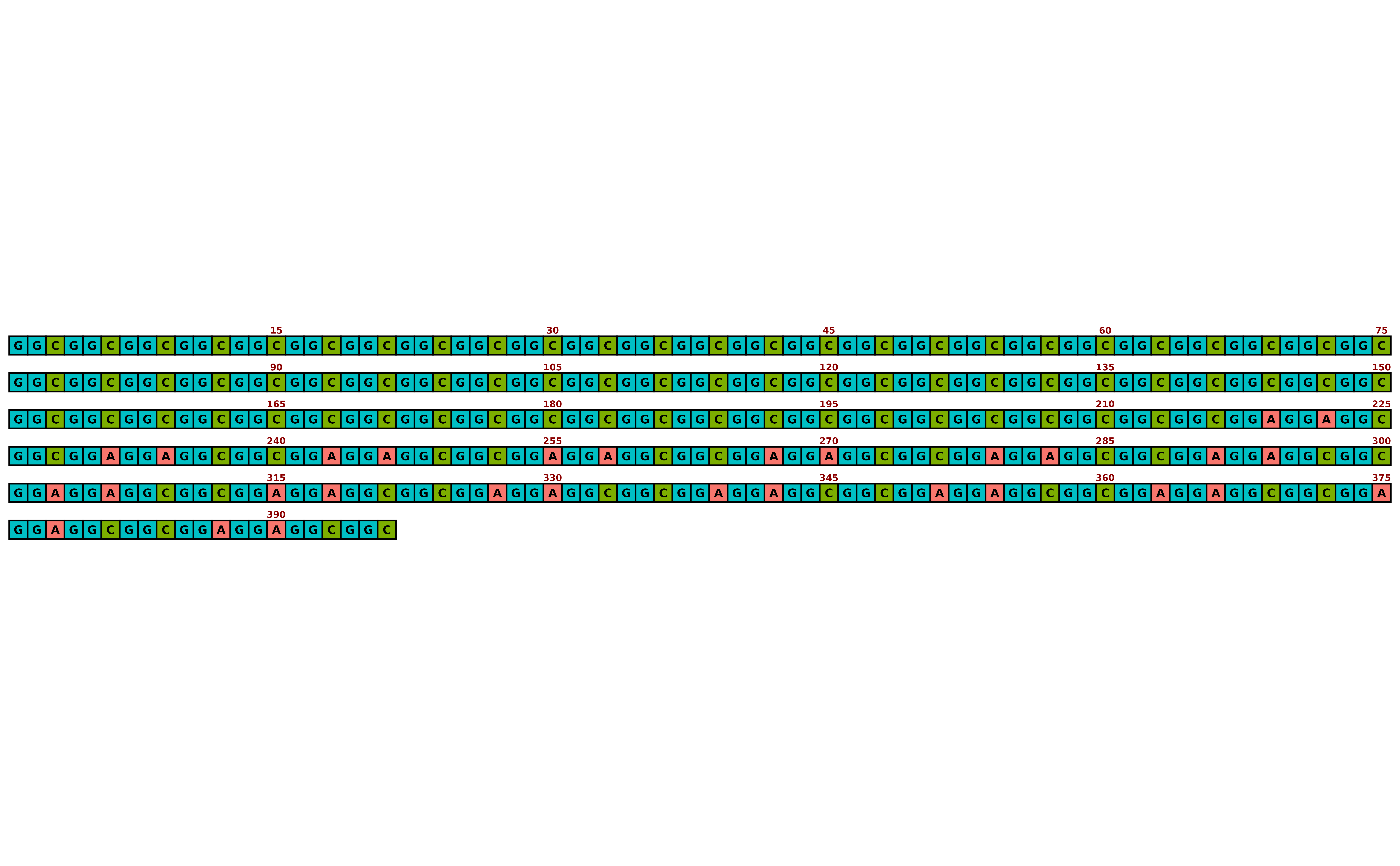
A ggplot object containing the full visualisation, or invisible(NULL) if return = FALSE. It is often more useful to use filename = "myfilename.png", because then the visualisation is exported at the correct aspect ratio.
Examples
# \donttest{
## Create sequence to visualise
sequence <- paste(c(rep("GGC", 72), rep("GGAGGAGGCGGC", 15)), collapse = "")
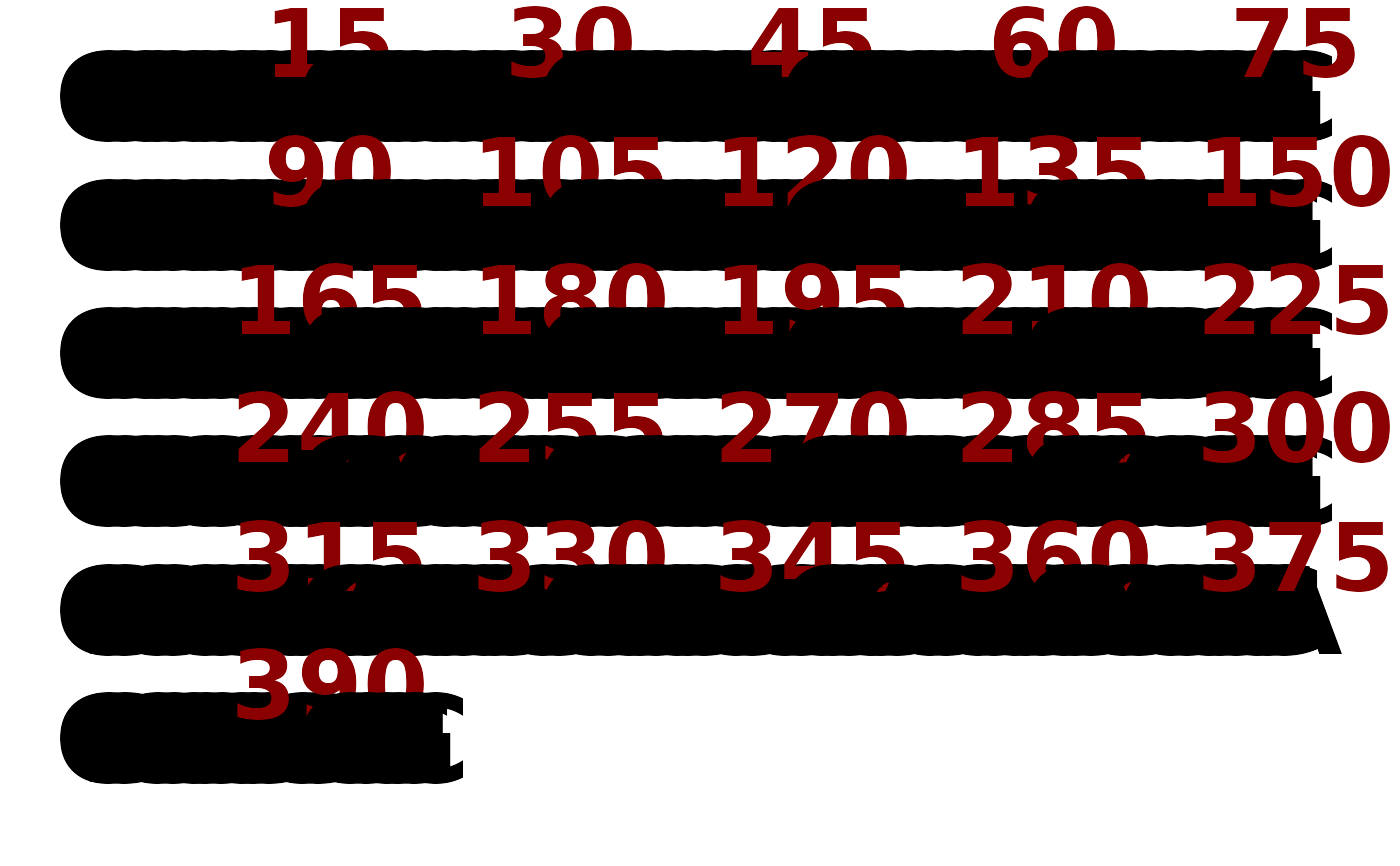
## Visualise with all defaults
## This looks ugly because it isn't at the right scale/aspect ratio
visualise_single_sequence(sequence)
 ## Export with all defaults rather than returning
visualise_single_sequence(
sequence,
filename = "example_vss_01.png",
return = FALSE
)
## View exported image
image <- png::readPNG("example_vss_01.png")
unlink("example_vss_01.png")
grid::grid.newpage()
grid::grid.raster(image)
## Export with all defaults rather than returning
visualise_single_sequence(
sequence,
filename = "example_vss_01.png",
return = FALSE
)
## View exported image
image <- png::readPNG("example_vss_01.png")
unlink("example_vss_01.png")
grid::grid.newpage()
grid::grid.raster(image)
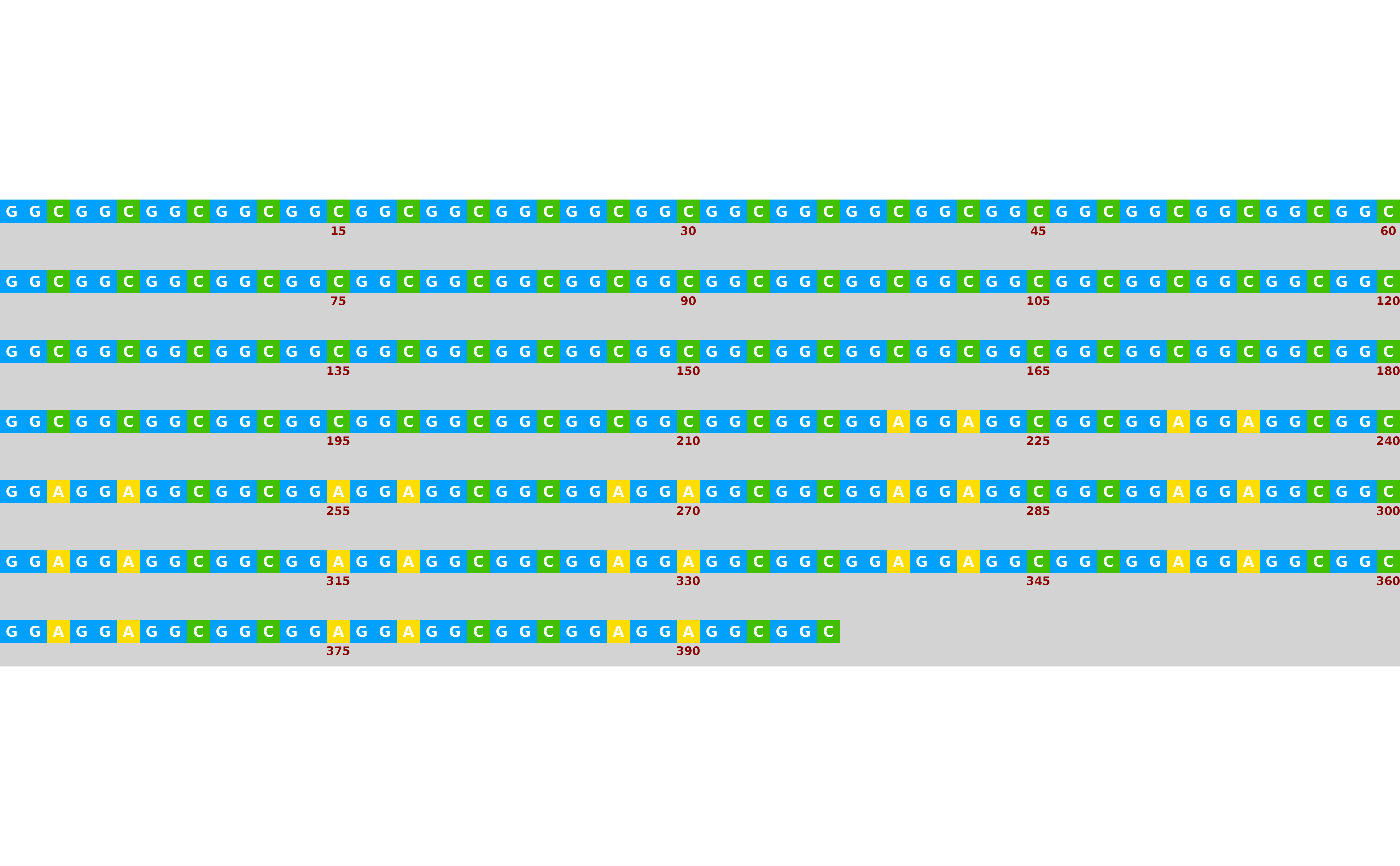
 ## Export while customising appearance
visualise_single_sequence(
sequence,
filename = "example_vss_02.png",
return = FALSE,
sequence_colours = sequence_colour_palettes$bright_pale,
sequence_text_colour = "white",
background_colour = "lightgrey",
line_wrapping = 60,
spacing = 2,
outline_linewidth = 0,
index_annotations_above = FALSE,
index_annotation_always_first_base = FALSE,
index_annotation_always_last_base = FALSE,
margin = 0
)
## View exported image
image <- png::readPNG("example_vss_02.png")
unlink("example_vss_02.png")
grid::grid.newpage()
grid::grid.raster(image)
## Export while customising appearance
visualise_single_sequence(
sequence,
filename = "example_vss_02.png",
return = FALSE,
sequence_colours = sequence_colour_palettes$bright_pale,
sequence_text_colour = "white",
background_colour = "lightgrey",
line_wrapping = 60,
spacing = 2,
outline_linewidth = 0,
index_annotations_above = FALSE,
index_annotation_always_first_base = FALSE,
index_annotation_always_last_base = FALSE,
margin = 0
)
## View exported image
image <- png::readPNG("example_vss_02.png")
unlink("example_vss_02.png")
grid::grid.newpage()
grid::grid.raster(image)
 # }
# }